The 7 Types of Harm True Crime Fans Create (And Why You Should Care)
Look, I need to confess something.
I've spent hours watching body cam footage of traffic stops. I've scrolled through Reddit threads at 2am trying to piece together timelines. I've listened to 911 calls that made my stomach drop. And the whole time, I've had this nagging feeling that something about all of this is deeply fucked up.
Not just the crimes themselves. The way we respond to them.
Nobody wants to admit that our collective obsession with true crime doesn't just observe tragedy. It creates new versions of it. We help solve cases, sure. But we also destroy innocent lives, spread misinformation like wildfire, and build a justice system where your chances of being found depend on whether you're pretty enough to trend on TikTok.
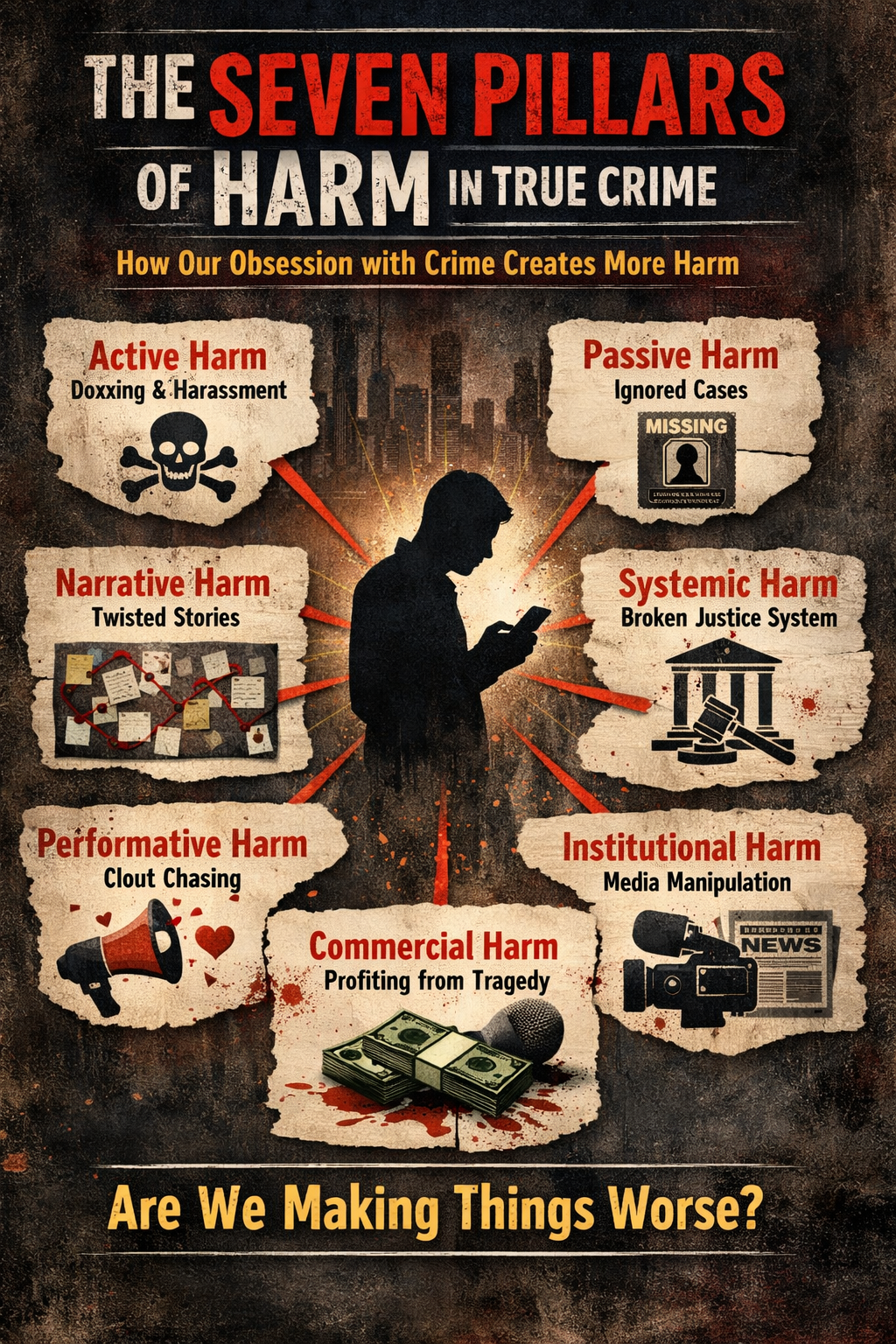
I'm a social psychology nerd who can't stop analyzing group behavior, and I've been trying to map out all the different ways our true crime consumption causes actual damage. Turns out there are seven distinct types. I'm calling them the Seven Pillars of Harm, because I'm pretentious like that and also because having a framework helps me sleep at night.
The Seven Ways We Screw This Up
1. Active Harm (The Stuff We Actually Do)
Death threats. Doxxing. Showing up at crime scenes with our phones out. Harassing families because we've decided someone is guilty based on vibes.
This is the obvious stuff. The harassment campaigns, the amateur detectives who become actual stalkers, the TikTokers who film themselves confronting "suspects" for views. When someone sends a mother death threats because the internet decided her missing daughter was probably a runaway, that's active harm.
It's the easiest type to identify because someone is clearly doing something terrible. We can point at it and say "that person is an asshole." Which is convenient because it lets the rest of us off the hook.
2. Passive Harm (The Crimes of Silence)
This one's sneakier. It's what happens when we care about some victims and not others.
While you were learning everything about Gabby Petito's life, Daniel Robinson was missing in the Arizona desert. Jelani Day disappeared the same week. Lauren Cho vanished around the same time. You probably don't know their favorite colors or what kind of music they liked, because passive harm is about absence.
We didn't actively hurt these families. We just didn't give a shit. And that indifference is its own form of violence.
3. Narrative Harm (When We Force Stories to Be What We Want)
Humans are pattern-matching machines, which is great for not getting eaten by predators but terrible for understanding complex criminal cases.
We take messy reality and jam it into familiar story shapes. The perfect victim. The obvious suspect. The shocking twist. We build theories that feel satisfying even when they're completely wrong. We reduce real humans to character archetypes because actual complexity is harder to process.
Every conspiracy theory, every "she was definitely having an affair" speculation based on nothing, every time we decide someone "seems guilty"—that's narrative harm. We're rewriting reality to fit our preferred plot structure.
4. Systemic Harm (The Big Broken Machine)
Some harm isn't about individual choices. It's baked into how the entire system operates.
Missing White Woman Syndrome isn't just media bias. It's police departments allocating resources based on public pressure. It's algorithms amplifying certain stories because they drive engagement. It's a feedback loop where attention determines resources, which determines outcomes, which determines whose life actually matters.
You can be the most ethical true crime consumer on the planet and systemic harm still operates around you. But our participation keeps the machine running.
5. Performative Harm (Main Character Syndrome Meets Tragedy)
Oh, you posted a missing person flyer to your Instagram story? How helpful. Did you actually call in any tips, or were you just demonstrating that you're the kind of person who cares about missing people?
Performative harm is using other people's tragedy as a stage for your own moral performance. It's the influencers who build entire brands on someone else's murder. It's the "raising awareness" that raises nothing except your own profile. It's treating real suffering as content.
The person still gets to feel like a good person while doing absolutely nothing useful. That's the insidious part.
6. Institutional Harm (When Organizations Make It Worse)
Media outlets deciding which cases to cover based on what drives clicks. Police departments going all-in on viral cases while letting others go cold. Platforms designing algorithms that reward sensationalism and allow harassment because engagement equals profit.
Institutions have power that individuals don't. When they make choices that prioritize profit or PR over actual justice, they create conditions for all the other types of harm to multiply.
7. Commercial Harm (The True Crime Industrial Complex)
Someone is making money off every tragedy. The podcasters, the YouTubers, the people selling "murderino" merch, the tour companies that take you to crime scenes.
I'm starting a true crime podcast, so I'm not exempt from this. But let's be real about what this is: an entire economy built on packaging human suffering as entertainment. Some of it funds good journalism. Most of it just funds more content creation.
Why I'm Telling You This
These categories aren't separate. They're tangled together, feeding each other, creating feedback loops that amplify harm.
But breaking them apart helps me see where my own behavior fits into the bigger picture. I might not send death threats, but I definitely consume sensationalized content. I don't doxx people, but I've definitely participated in narrative harm by accepting storylines that felt right without checking if they were true.
This framework isn't about guilt. It's about precision. When you can name exactly what type of harm is happening, you can start asking better questions about your role in it.
Because here's the uncomfortable truth: if you consume true crime content, you're part of this system. The question isn't whether you participate. It's how you participate, and whether you're willing to look at what your participation creates.
I built this taxonomy because I needed a way to think clearly about my own complicity. Now I'm sharing it because maybe you need that too.
We're going to use this framework throughout the podcast to dissect specific cases. Not to shame anyone, but to understand what we're actually doing when we collectively obsess over crime.
The crime we create isn't simple. It operates at seven different levels, through different mechanisms, with different consequences. But once you can see the full structure, you can't unsee it.
And maybe that's where change starts.
